







SSC Stenographer Selection Process 2026: Stages & Details

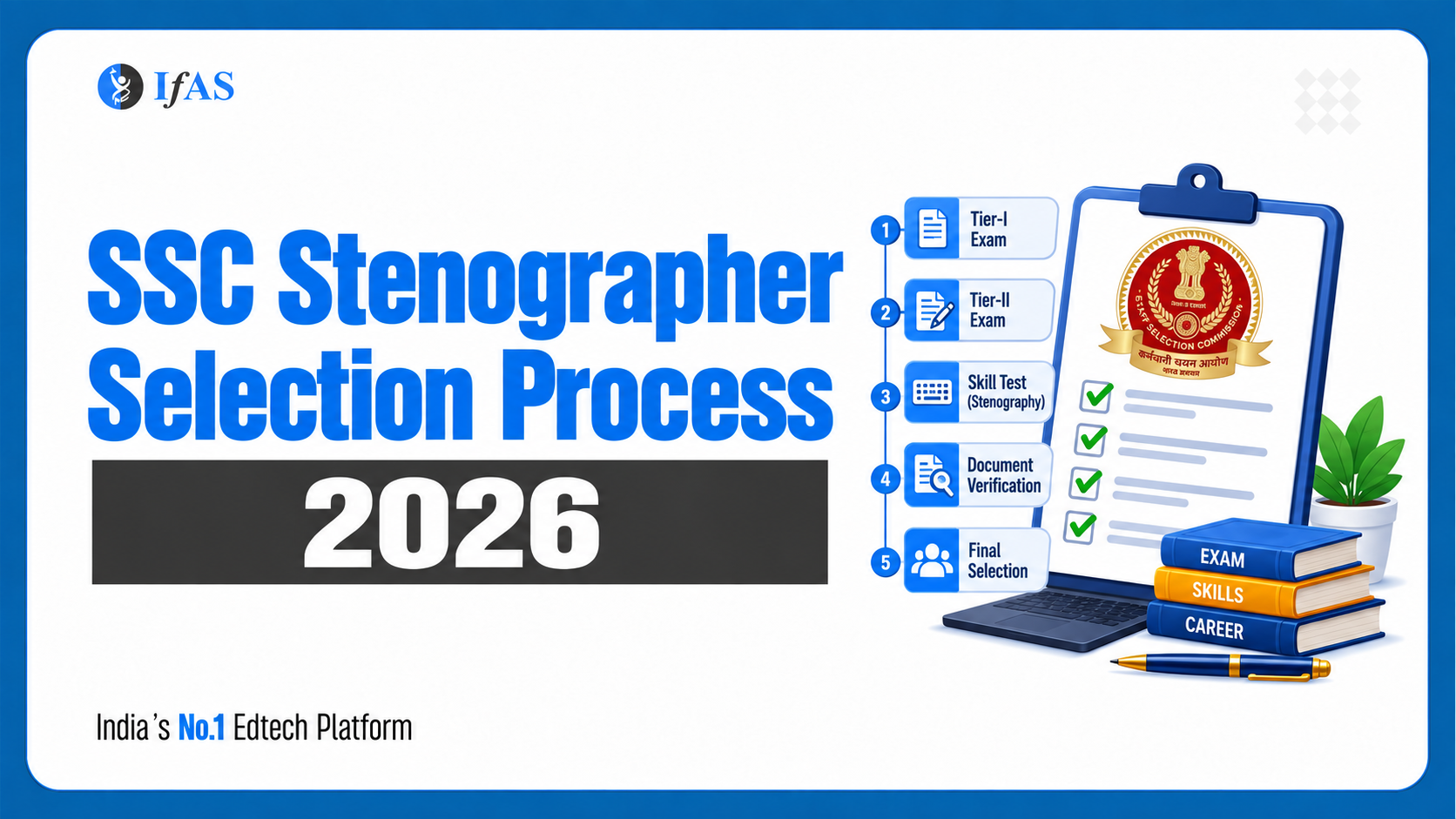
Understanding each stage of the SSC Stenographer selection process is important because candidates need to prepare for both the written examination and the stenography assessment. After completing the applicable stages, shortlisted candidates undergo document verification before final selection and allocation.
SSC Stenographer Selection Process 2026: Stages
The recruitment process consists of the following major stages:
- Computer Based Examination (CBE)
- Stenography Skill Test
- Document Verification
- Final Selection and Allocation
Stage 1: SSC Stenographer Computer Based Examination
The Computer Based Examination is the first major stage of the SSC Stenographer selection process. It tests candidates across three sections: General Intelligence & Reasoning, General Awareness, and English Language & Comprehension.
Subject | Questions | Marks | Duration |
|---|---|---|---|
General Intelligence & Reasoning | 50 | 50 | 30 Minutes |
General Awareness | 50 | 50 | 30 Minutes |
English Language & Comprehension | 100 | 100 | 60 Minutes |
Total | 200 | 200 | 2 Hours |
The examination consists of objective-type multiple-choice questions. The paper is conducted in English and Hindi, except for the English Language and Comprehension section.
There is a negative marking of 0.25 marks for every incorrect answer. Candidates should therefore focus on maintaining accuracy while attempting questions.
Stage 2: SSC Stenographer Skill Test
Candidates who qualify the Computer Based Examination are shortlisted for the Stenography Skill Test. This stage assesses shorthand and transcription skills in English or Hindi.
Candidates are given a 10-minute dictation at the prescribed speed according to the grade for which they have applied.
Grade | Dictation Speed | English Transcription | Hindi Transcription |
|---|---|---|---|
Grade C | 100 words per minute | 40 Minutes | 55 Minutes |
Grade D | 80 words per minute | 50 Minutes | 65 Minutes |
The Skill Test requires candidates to accurately take dictation in shorthand and transcribe the dictated matter on a computer within the prescribed time.
Regular practice is important because candidates need to develop a balance between shorthand speed, transcription accuracy, concentration, and time management.
Stage 3: Document Verification
Candidates who qualify the applicable stages are required to undergo Document Verification. During this stage, candidates need to produce the original documents supporting the information provided in their application.
These documents may include proof of educational qualification, date of birth, category, nationality, and other applicable certificates.
Candidates should ensure that the details mentioned in their application form match their original documents. Keeping all certificates organised in advance can make the verification process smoother.
Stage 4: Final Selection and Allocation
After the completion of the applicable selection stages and document verification, SSC carries out the final selection and allocation process according to the prescribed recruitment rules.
The allocation may depend on factors such as merit, candidate preferences, category, available vacancies, and applicable departmental requirements.
Candidates should therefore carefully provide their preferences wherever SSC asks for them during the recruitment process.
SSC Stenographer Grade C vs Grade D
The two posts have different stenography speed requirements.
Particular | Grade C | Grade D |
|---|---|---|
Group | Group B Non-Gazetted | Group C |
Dictation Speed | 100 wpm | 80 wpm |
Skill Test | Required | Required |
English Transcription | 40 Minutes | 50 Minutes |
Hindi Transcription | 55 Minutes | 65 Minutes |
SSC Stenographer Selection Process: Important Points
Selection Stage / Factor | Detailed Information |
|---|---|
Computer Based Examination | The CBE is the first major stage and assesses candidates in General Intelligence & Reasoning, General Awareness, and English Language & Comprehension. |
CBE Qualification | Candidates must qualify the CBE according to the applicable shortlisting criteria to proceed to the Stenography Skill Test. |
Stenography Skill Test | The Skill Test evaluates shorthand and transcription ability through a 10-minute dictation followed by computer-based transcription. |
Grade-Wise Speed | Grade C candidates take dictation at 100 words per minute, while Grade D candidates take dictation at 80 words per minute. |
Test Language | Candidates can take the Skill Test in English or Hindi, according to the applicable examination requirements. |
Transcription Ability | Candidates must accurately transcribe the dictated passage within the prescribed time. Speed and accuracy are both important. |
Document Verification | Shortlisted candidates must produce original documents supporting their educational qualification, age, category, and other application details. |
Final Selection | Final selection and allocation are carried out according to applicable SSC rules, merit, preferences, category, vacancies, and other relevant conditions. |
Original Documents | Candidates should keep their original certificates and supporting documents ready for verification. |
Preparation Approach | Candidates should prepare for the CBE and Skill Test together rather than waiting for the CBE result to begin stenography practice. |
How to Approach Each Stage of the Selection Process
Build a Strong CBE Foundation
Candidates should first develop a balanced preparation strategy for all three CBE sections. Regular practice of previous year questions and mock tests can help improve accuracy, speed, and familiarity with the examination format.
Start Skill Test Practice Early
Candidates should not wait for the CBE result before starting stenography practice. Developing shorthand speed and transcription accuracy takes consistent practice, so skill preparation should continue alongside written-exam preparation.
Focus on Accuracy Along With Speed
The Skill Test requires candidates to handle dictated content accurately within a fixed time. Increasing speed without maintaining accuracy can lead to transcription errors. Candidates should therefore gradually improve speed while maintaining control over accuracy.
Practise Under Timed Conditions
Candidates should regularly practise dictation and transcription using a fixed time limit. Simulating examination conditions can improve concentration and help candidates become comfortable working under time pressure.
Keep Documents Ready
Candidates should organise their educational, identity, category, and other relevant documents before the verification stage. Early preparation can help avoid difficulties after qualifying the examination stages.
Track Progress Separately
Candidates can maintain separate records for CBE scores, shorthand speed, transcription accuracy, and mock-test performance. This makes it easier to identify which part of the selection process needs additional attention.
SSC Stenographer Selection Process: Preparation Strategy
A successful preparation plan should cover both the written examination and the Skill Test. Candidates should divide their preparation time according to their current strengths and weaknesses.
For the CBE, regular practice of Reasoning, General Awareness, and English should be combined with previous year papers and mock tests. Candidates should analyse their mistakes and work on improving accuracy and question selection.
For the Skill Test, daily shorthand and transcription practice is recommended. Candidates should gradually increase their dictation speed while ensuring that transcription remains accurate and is completed within the prescribed time.
Common Mistakes to Avoid
Candidates should avoid focusing entirely on the Computer Based Examination and postponing Skill Test preparation. Stenography requires continuous practice, and attempting to develop speed shortly before the Skill Test can be difficult.
Other common mistakes include ignoring accuracy, not practising under time limits, failing to analyse mock-test performance, and leaving document preparation until the final stage.
SSC Stenographer Selection Process: Quick Overview
Stage | Purpose |
|---|---|
Computer Based Examination | Tests Reasoning, General Awareness and English |
Stenography Skill Test | Tests shorthand and transcription ability |
Document Verification | Verifies candidate details and supporting documents |
Final Selection & Allocation | Selection based on applicable rules, merit, preferences and vacancies |
Final Takeaway
The SSC Stenographer Selection Process 2026 requires candidates to clear the Computer Based Examination and then qualify the applicable Stenography Skill Test before proceeding through document verification and final selection.
Candidates should prepare for the entire selection process from the beginning. A combination of CBE practice, previous year papers, mock tests, shorthand training, timed dictation, transcription practice, and document readiness can help candidates approach each stage with greater confidence.